


A Complete Guide to Jointless Concrete Flooring for Warehouses and Factories
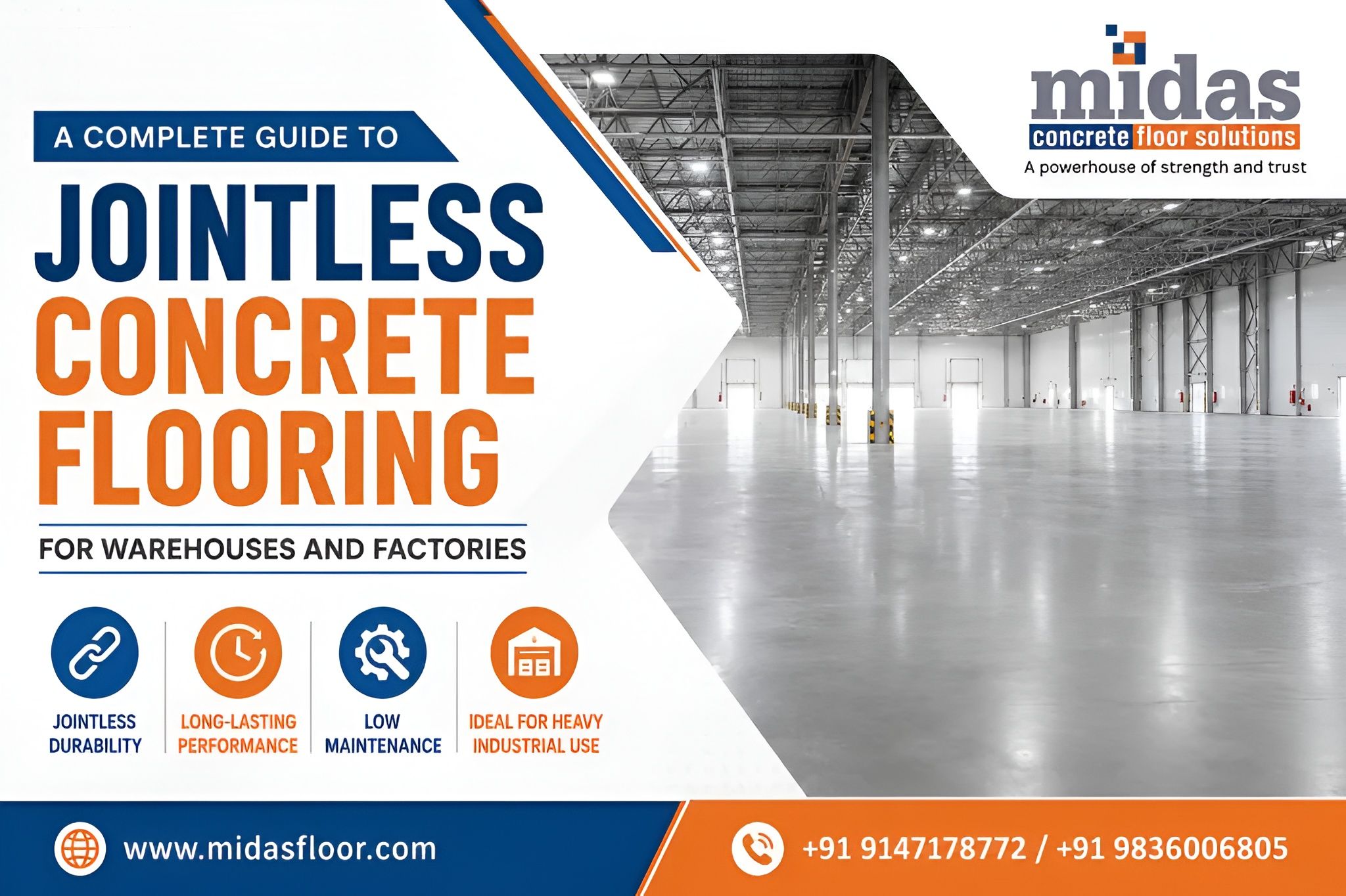
Modern warehouses and factories demand flooring systems that can withstand heavy machinery, continuous forklift movement, and high operational loads without frequent repairs. Traditional concrete floors, with their numerous expansion and contraction joints, often become weak points that require regular maintenance. This is why many industrial developers today prefer working with the best jointless concrete floors contractors in India to install durable, seamless flooring systems.
Jointless concrete flooring has transformed industrial construction by minimizing joints, improving floor performance, and reducing maintenance costs. In this guide, we’ll explore everything you need to know about jointless concrete floors, their benefits, applications, construction process, and why Midas Floor Solutions is a trusted name for large-scale industrial flooring projects.
What Is Jointless Concrete Flooring?
Jointless concrete flooring is an advanced flooring system where large concrete panels are cast with minimal or no contraction joints. Unlike conventional floors that require saw-cut joints every few metres, jointless floors use optimized concrete mix designs, steel fibre reinforcement, shrinkage-control techniques, and precision laser screed technology to create large continuous slabs with superior performance.
The result is a stronger, smoother, and longer-lasting industrial floor capable of handling demanding operating conditions.
Why Traditional Concrete Floors Develop Problems
Conventional concrete floors contain multiple joints that accommodate concrete shrinkage. Over time, these joints often become the weakest areas of the floor.
Common issues include: • Joint spalling • Edge breakage • Forklift vibration • Uneven floor surfaces • Increased tyre wear • Dust generation • Frequent maintenance • Water and chemical penetration through joints
These problems not only increase repair costs but also affect productivity inside warehouses and manufacturing plants.
Benefits of Jointless Concrete Flooring
Exceptional Durability
With significantly fewer joints, the floor experiences less stress concentration and is better equipped to withstand heavy industrial traffic for years.
Smooth Material Handling
Forklifts, pallet trucks, AGVs, and other material handling equipment can move more smoothly over continuous surfaces, reducing vibration and improving operational efficiency.
Lower Maintenance Costs
Since joints are among the first areas to deteriorate in traditional floors, minimizing them dramatically reduces repair requirements and lifecycle maintenance expenses.
Higher Load-Bearing Capacity
Jointless concrete floors are engineered to support heavy racks, industrial machinery, storage systems, and repetitive dynamic loads.
Improved Floor Flatness
Using laser screed technology allows contractors to achieve highly level surfaces suitable for modern warehouses and automated logistics facilities.
Better Hygiene
Fewer joints mean fewer places for dust, dirt, moisture, and contaminants to accumulate, making cleaning easier in food processing, pharmaceutical, and manufacturing facilities.
How Jointless Concrete Floors Are Constructed
Installing a high-performance jointless floor requires careful planning and precision engineering.
1. Subgrade Preparation
The base is compacted and levelled to provide a stable foundation capable of supporting industrial loads.
2. Optimized Concrete Mix Design
High-strength concrete, typically in the M30 to M50 range, is combined with steel fibers and shrinkage-reducing admixtures to control cracking and improve durability.
3. Large Area Concrete Placement
Concrete is poured continuously over large sections, minimizing the number of construction joints.
4. Laser Screed Levelling
Laser-guided screed machines automatically level and compact the concrete, producing highly accurate floor flatness and levelness.
5. Surface Finishing
Power trowelling creates a dense, abrasion-resistant surface, while proper curing enhances long-term strength and durability.
Where Are Jointless Concrete Floors Used?
Jointless flooring is suitable for a wide range of industrial environments, including:
- Warehouses
- Logistics parks
- Distribution centres
- Manufacturing plants
- Automotive factories
- Pharmaceutical facilities
- Food processing units
- Cold storage facilities
- Industrial workshops
- High-bay storage warehouses
Jointless Floors vs Conventional Concrete Floors
Jointless Concrete Floor
Number of joints - Very few Maintenance - Low Forklift movement - Smooth Load distribution - Excellent Long-term durability - High Operational downtime - Minimal
Conventional Concrete Floor
Number of joints - Numerous Maintenance - High Forklift movement - Interrupted by joints Load distribution - Moderate Long-term durability - Moderate Operational downtime - Higher due to repairs
What Makes Midas Floor Solutions Stand Out?
Among the best Jointless Concrete Floors Contractors in India, Midas Floor Solutions has established itself through engineering expertise, advanced equipment, and specialized industrial flooring solutions.
Advanced Laser Screed Technology
Midas uses modern laser screed systems that deliver highly accurate floor flatness while improving construction speed and consistency.
Expertise in Large Industrial Projects
The company specializes in flooring for warehouses, manufacturing plants, logistics parks, and commercial facilities across India, providing solutions that comply with demanding industrial requirements.
TR34-Compliant Flooring Solutions
Midas delivers flooring systems designed to meet TR34 guidelines, making them suitable for facilities that require precision floor tolerances and reliable performance.
Complete Industrial Flooring Services
Beyond jointless floors, Midas offers:
- Laser Screed FM2 Floors
- Super Flat DM1 & DM2 Floors
- Floor Densification
- FM3 Mezzanine Floors
- Coloured Concrete Floors
- Floor Restoration
- Decorative Concrete
- Annual Floor Maintenance
This comprehensive portfolio enables clients to source multiple flooring solutions from a single experienced contractor.
Engineering-Driven Approach
From floor design and concrete mix optimization to execution and post-installation support, Midas follows a systematic engineering process to ensure long-lasting floor performance.
Factors to Consider When Choosing Jointless Concrete Floor Contractors
Before selecting a contractor, evaluate:
- Experience with industrial flooring
- Availability of laser screed equipment
- Knowledge of TR34 standards
- Expertise in steel fibre reinforced concrete
- Proven project portfolio
- Technical design capabilities
- Quality assurance procedures
- Post-installation support
Choosing an experienced contractor ensures better floor performance and lower lifecycle costs.
Why Warehouses Are Switching to Jointless Floors
As warehouses become larger and increasingly automated, floor quality has become a critical factor in operational efficiency.
Jointless concrete floors offer:
- Faster forklift movement
- Reduced equipment wear
- Improved worker safety
- Better rack stability
- Lower maintenance expenses
- Longer service life
- Improved productivity
These advantages make them an ideal investment for modern logistics and manufacturing facilities.
Conclusion
Jointless concrete flooring has become the preferred solution for warehouses and factories that require durable, high-performance industrial floors with minimal maintenance. By eliminating unnecessary joints, these systems provide superior strength, smoother operations, and lower lifecycle costs.
When selecting among the best Jointless Concrete Floors Contractors in India, businesses should look for technical expertise, advanced construction technology, and proven industrial experience. Midas Floor Solutions combines laser screed technology, TR34-compliant flooring practices, and specialized engineering knowledge to deliver reliable jointless concrete flooring solutions for warehouses, logistics parks, factories, and industrial facilities across India.